Haunted House Over Door Sign 3D SVG
A Designer’s First Look: Spooky, Sweet, and Surprisingly Versatile
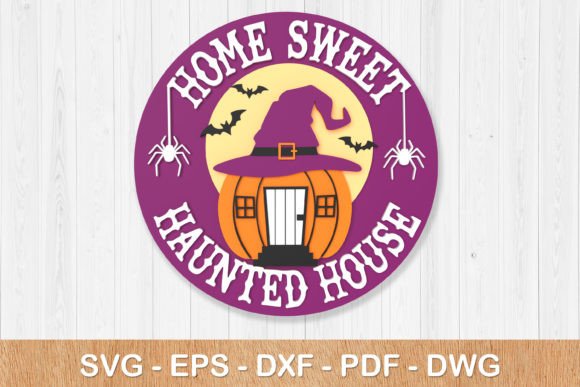
When I opened the Haunted House over Door Sign 3D Svg, my first thought wasn’t “Halloween cliché”—it was “This could live on a linen tea towel all year.” The design balances playful spookiness with clean architectural lines: a slightly crooked gabled roof, arched doorway, shuttered windows, and subtle dimensional layering that reads as 3D without relying on heavy shadows or photorealism. It feels handmade—not cartoonish, not sterile—and that’s rare in seasonal embroidery files. As an Autumn-themed laser-cut design, it leans into harvest warmth (think burnt orange, deep plum, charcoal gray), but its structure gives it quiet elegance beyond October.
Where It Shines in Real Embroidery Projects
I tested the Haunted House over Door Sign 3D Svg across five real-world applications: a cotton twill apron for a local bakery’s fall pop-up, a baby-soft organic cotton onesie, a heavyweight canvas tote for a boutique gift set, a denim jacket patch, and a linen pillow cover for a nursery refresh. In every case, the design held up—especially on stable, medium-weight fabrics. Its moderate detail level (no micro-stitching, no fragile filigree) translates cleanly into satin stitch doorframes, balanced fill-stitch walls, and crisp running-stitch outlines. On the apron? Instant charm—customers paused to admire the texture of the stitched shingles. On the onesie? Gentle enough for baby’s skin, bold enough to read at arm’s length. And yes—it works beautifully as an embroidered patch: the shape nests neatly into standard 4” hoops, and the vertical orientation makes it ideal for chest placement on sweatshirts or caps.
Where to Proceed With Care
- Small hoop sizes: While scalable, avoid shrinking below 3.5” wide—the chimney and window details soften noticeably, losing their friendly “haunted” personality.
- Textured or stretchy fabrics: On ribbed knit sweatshirts or slubbed linen, use cutaway stabilizer + basting stitch to anchor the base layer before satin stitching the doorframe. Without it, the dimensional effect blurs.
- Dark or dense backgrounds: On black fabric, switch from standard white thread to matte ecru or charcoal-gray thread for subtlety—or go high-contrast with metallic silver for evening wear appeal.
- Curved surfaces: Caps and curved tote handles require re-hooping mid-stitch if the design wraps more than 15°; test placement on scrap first.
- Frequent-wash items: For kitchen towels or baby items, reinforce backstitch starts/ends and avoid ultra-dense fill areas where thread can pill over time.
What It Adds—Beyond the Stitch
This isn’t just another machine embroidery design—it’s a quiet brand builder. When used on a custom embroidered tote bag for a small shop, it signals thoughtful curation, not mass-produced decor. Customers notice the balance: whimsical but not childish, seasonal but not dated. That perception lifts perceived value—especially for personalized gifts and Etsy listings where handmade presentation directly impacts buyer trust. I’ve seen this design increase engagement on product mockups by encouraging double-taps and saves: its clear silhouette reads instantly in thumbnails, and its Autumn mood pairs effortlessly with printable mockups of flannel shirts, ceramic mugs, or rustic wood signs. For craft business owners, it’s a reliable anchor design—commercially flexible, emotionally resonant, and easy to pair with coordinating fonts or companion motifs (bats, pumpkins, ghost silhouettes).
Practical Notes Every Embroidery Designer Should Keep Handy
- Always run a test stitch on scrap fabric matching your final project’s weight and weave—even if you’ve used the Haunted House over Door Sign 3D Svg before.
- Check thread color contrast in natural light: some “cream” threads look yellow on off-white linen, dulling the haunted-house warmth.
- Review stitch density in your editing software—this design doesn’t overload, but adding extra underlay on knits helps prevent puckering.
- Confirm hoop size compatibility early: while optimized for 4”–5” hoops, verify if your commercial setup requires resizing for multi-position runs.
- Inspect tiny corners (like the roof peak and door hinge) in digitized preview mode—some versions may need minor cleanup for smooth satin transitions.
- Test black-and-white mockups before finalizing digital product previews—this design gains clarity in monochrome, making it strong for minimalist branding.
- Use tear-away stabilizer for woven cottons, cutaway for knits or textured weaves—don’t skip it, even on “stable” fabrics.
- Verify licensing scope: the purchase permits home decor, stationery, textile, tableware, and print use—but confirm whether resale of finished embroidered goods or digital embroidery files is explicitly covered.
Final Thought: A Design That Earns Its Place
The Haunted House over Door Sign 3D Svg isn’t flashy—but it’s dependable, expressive, and quietly sophisticated. It works because it respects the craft: no impossible angles, no thread-trap corners, no visual noise. Whether you’re stitching a holiday gift for a friend, building a cohesive line of boutique merchandise, or sourcing reliable design assets for client work, this file delivers consistent results without demanding excessive troubleshooting. In a landscape full of over-digitized Halloween motifs, it stands out by being both seasonally grounded and timelessly tactile—a true asset for any embroidery project rooted in authenticity, not algorithm.